Thursday, January 26, 2012

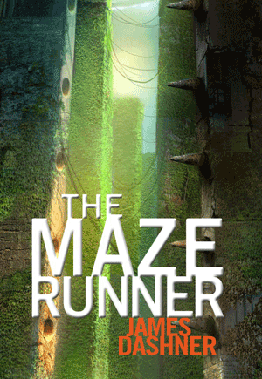
The Maze Runner by James Dashner

This post is also found on my other blog The Critical Reader.

Book one in The Maze Runner trilogy

Publisher: Delacorte Press
Publication Date: October 2009
Hardcover: 384 pages

Genre: Young Adult, Dystopian Future, Science Fiction
Rating: ★★★★★ - Excellent

"When Thomas wakes up in the lift, the only thing he can remember is his first name. His memory is blank. But he’s not alone. When the lift’s doors open, Thomas finds himself surrounded by kids who welcome him to the Glade—a large, open expanse surrounded by stone walls.

Just like Thomas, the Gladers don’t know why or how they got to the Glade. All they know is that every morning the stone doors to the maze that surrounds them have opened. Every night they’ve closed tight. And every 30 days a new boy has been delivered in the lift.

Thomas was expected. But the next day, a girl is sent up—the first girl to ever arrive in the Glade. And more surprising yet is the message she delivers.

Thomas might be more important than he could ever guess. If only he could unlock the dark secrets buried within his mind." -Amazon.com

I first found this book when I was browsing through the local library's book listings. I wanted to read something in roughly the same genre as The Hunger Games. When The Maze Runner popped up, I thought it looked interesting enough and the title was certainly intriguing.

Positive Elements -
First of all, I have to say that the idea for this book was a great one. I love the air of mystery that surrounds everything and everyone. Why a maze? Are the characters there because of past crimes? Where did the Grievers come from? Who created the maze? Why does it seem familiar to Thomas? Why are there doors to the maze and why do they close at night? There are so very many questions posed throughout the book, and that fact alone kept me interested.

Not only that, but I loved the suspense and surprise that came with every turn of the page. Thomas was quite intriguing, as was the girl, Theresa. While the novel may have been written for teens around the age of thirteen, it is constructed in such a way that even adults can be drawn in.

There really isn't a specific time period laid out here in The Maze Runner. It kind of gives you leave to fill in the blanks with your imagination. The really nice thing about such a book is that one can judge the actions of an insane world from a distance.

Even though the world the main characters live in is not safe, and they don't know what might happen next, they still act on their consciences and risk their lives for others. Thomas is a great role model as he sets a strong example by doing what he knows is right. He even risks his own safety and puts his life on the line to save others. Friendship is valuable to Thomas and he goes to great lengths in order to protect even one friendship.

There isn't really any crude or profane language as Mr. Dashner invents his own words and terms. It's quite nice, actually, to have a book you can read without worrying that the next time you turn the page you'll be confronted with all sorts of swear words.

There is no sexual content in this book.

Negative Elements -
The world The Maze Runner is set in is a very violent one. Children are chosen and used as pawns and the characters face mortal danger from half-machine, half-animal monsters called Grievers outside the walls and boys inside the walls. The Grievers sting or kill people - and those that are stung go insane. One boy attacks another boy by biting him and trying to kill him; he is then shot with an arrow. Another boy tries to strangle himself. It is said that a boy who once tried to escape was sliced in two in the attempt. The Grievers are attacked by the boys with guns, knives, and spears. Children are murdered, disease runs rampant, and there is a scene where multiple characters are killed by gunfire - and one with a knife. The characters witness a woman being repeatedly shot. A bus runs over another woman.

Summary -
While the violence isn't overly graphic, I would definitely recommend this book for 13+ as the violence is fairly disturbing.

I do think that after reading this book, you'll be dying to read the next one: The Scorch Trials. The Maze Runner is definitely a page turner and a great new series to have available. Thank you, Mr. Dashner!

Tuesday, January 10, 2012

Why Sarah likes the Uglies

Scott Westerfield's Uglies, Pretties, Specials, and Extras, have long been among my favorite books. I recommend them easily, because not only are they entertaining, but they contain very little questionable content that parents would need to be wary of. IF YOU LIKE HUNGER GAMES, YOU WILL LOVE UGLIES! (see previous Hunger Games rant in my last post) Here are a few reasons I like the Uglies series, followed by some things parents may want to be aware of. But first, a brief, and admittedly poorly written, plot summary from Westerfield's blog:

"Uglies is set in a world in which everyone has an operation when they turn sixteen, making them supermodel beautiful. Big eyes, full lips, no one fat or skinny. You might think this is a good thing, but it’s not. Especially if you’re one of the Smokies, a bunch of radical teens who’ve decided they want to keep their own faces. (How anti-social of them.) Uglies is a trilogy-plus-one, with Extras being a “companion novel” and told from a different point of view. All four Uglies books have been New York Times bestsellers!"
      -http://scottwesterfeld.com/books/uglies/

Why I like the Uglies:

  • Positive messages:
    • "Pretty has a price." The messages here are easy to see. Especially in Uglies, the under-lying message of true beauty is clear, but without becoming preachy. Many references are made to the "Rusties" (That's us) and how beauty (and the lack thereof) is what caused racism, jealousy, wars, and all other downfalls of humanity. But the issue is also raised throughout the story about how making everyone gorgeous isn't enough- or in other words, beauty isn't really the issue here. Lots to talk and think  about. 
    • "There's more to life than pretty." I really don't think I need to elaborate on this one- it speaks for itself.
    • "Mindless fun is stupid." This one isn't as blatant as the messages about beauty, but it's still clearly there. The "pretties" and their "party all night sleep all day, drink your cares away" attitudes are not portrayed as positive things. Even in Pretties, when the main character (Tally Youngblood) herself is immersed in the petty world of the pretties, the constant partying is seen as, well, stupid, unintelligent, and pointless.
    • "You are who you choose to be". I'll try to address this one without any spoilers. Tally is constantly pressured and sometimes forced to fit into the molds of what others (the Smokies, the City Government, her friends) want her to be. The books highlight Tally's struggle to break those bonds and be who she (and no one else) chooses to be. I won't say how, but she eventually achieves this.
    • "We need to take better care of the world, and each other." Again, without being preachy or shoving it down your throat, Westerfield masterfully makes his point. The story of our civilization destroying itself through greed and lazyness is mentioned several times, as are the consequences. The way that we nearly destroyed the planet is talked about too. The City is obsessed with recycling and renewable energy (probably the only good thing about the City).
  • Entertaining: This series is full of suspense and is just simply fun to read. There is tons of action, lots of funny dialogue, and of course romance.
  • No dark story line! Recent teen books all have one thing in common it seems: DARK THEMES. This isn't seen in this quartet. While there are some creepy moments, and some mildly scary concepts, none of it is dark or spiritual. 
What to watch out for:
Not much. These books are pretty clean, but here's a breakdown anyway.
  • Violence: Okay, honestly there is some, but none of it is gory. Can't really have an action sci-fi story without some violence, right? Nothing much beyond hand-to-hand combat and some bombing in Specials
  • Sex: None in Uglies beyond a couple of kisses and a couple making out vaguely mentioned in passing (they are pretties, so whatever they do is portrayed as "bubble-headed"). Pretties is really the only book of the series with anything to watch out for. Tally and Zane begin to sleep in the same room, but it isn't implied or even suggested that they are having sex. Nothing is described beyond waking up in the same room. Also some mention of pleasure gardens, where pretties are known to.... take pleasure. All of this, in my opinion, can be over-looked or talked through. Specials has one kiss, and Tally is said to be naked in an operating room and prison cell (nothing described).
  • Language: None in Uglies (unless "you suck" can be counted as language). A "hell" and "damn" in Pretties. A "hell" in Specials.
  • Drugs/ Alcohol: Quite a bit in the first two books (especially Pretties), but none of it portrayed in a positive light. In Extras, characters drink champagne. Lots of social drinking.
Conclusion:
I LOVE this quartet. And I think you will too. Hunger Games fans, prepare to have a new (and way more worth-while) obsession. :) In a world where most contemporary literature carry's a dark and menacing theme, Uglies stands out. Happy reading!

Monday, January 9, 2012

Sarah on Hunger Games

Those of you that know me well know that I am NOT a Hunger Games fan. If you would like to know my reasons for generally despising the trilogy, I'll give a condensed version here: PLAGIARISM. My favorite, favorite, FAVORITE book series, the Uglies trilogy by Scott Westerfield, debuted in 2005. Theses books featured a high-tech world three hundred years from now that worships beauty.

I won't say much on the subject here, although you could easily get me to rant on the subject for a length of time, but the main thing is this: 90% of the technology described in the Capitol (Hunger Games) is copied from New Pretty Town (Uglies) Hovercars? Check. Crazy tattoos on your face? Check. Weapons that interact with you? Check. Crazy fashions and "bubbly", annoying personalities? Check.

And that, my friends, is the primary reason I have never been a big fan of the highly- popular series.Uglies is the best book I have ever read, Hunger Games is nothing but a cheap, poorly written, copy-cat, and yet Hunger Games gets all the attention. Go figure.

That said, I recently finished Mockingjay, figuring I should know what I'm ranting about. And here's the thing: for most of the book, I liked it. I was seriously considering changing my view of the book series and joining the crowds of people who are part of the Hunger Games craze. Until the end.

WORST BOOK ENDING EVER.

I won't describe it, so as not to ruin it for any of you who haven't read it (though if you havent, I would say DONT), but my guess is that even you fans can't stand the ending.  So here's what we have:

Neat concept + poor writing + cheap romance + plagiarized technology/ personalities + unnecessary nudity + dumb ending = ? You be the judge.